
Sex Offender Checks in Clay County
The official route for a Clay County sex offender check is the Alabama Law Enforcement Agency Sex Offender Registry. ALEA maintains the statewide public record, while local law enforcement registers people and sends current information, photographs, and fingerprints to the state. ALEA says the public site updates daily in real time from those local submissions. That makes the registry more useful than an old saved result, but it does not make each address infallible. A move, an update in progress, or suspected noncompliance still calls for local confirmation.
Begin with the closest reliable facts, such as a full name or known place. Read the whole profile instead of relying on a map marker or name alone. Similar names can point to different people. The Clay County Sheriff's Office is the local contact for routine registration questions and an address concern. A person should report the concern, not visit the address or confront anyone. Emergency threats still go to 911.
Clay County Registry Updates
Clay County registry information begins at the local level. A registrant reports in person to local law enforcement, the agency records the required facts, and the submission moves to ALEA for public display. ALEA's general schedule calls for in-person verification during the person's birth month and every three months after that. Changes in residence or other required facts also pass through the local agency. The cycle explains why a public listing can be current yet still need a call to the Clay County Sheriff's Office when the facts on the ground appear different.
The ALEA registry information page is the source for the update and verification rules. Its official explanation is shown in the captured page below.
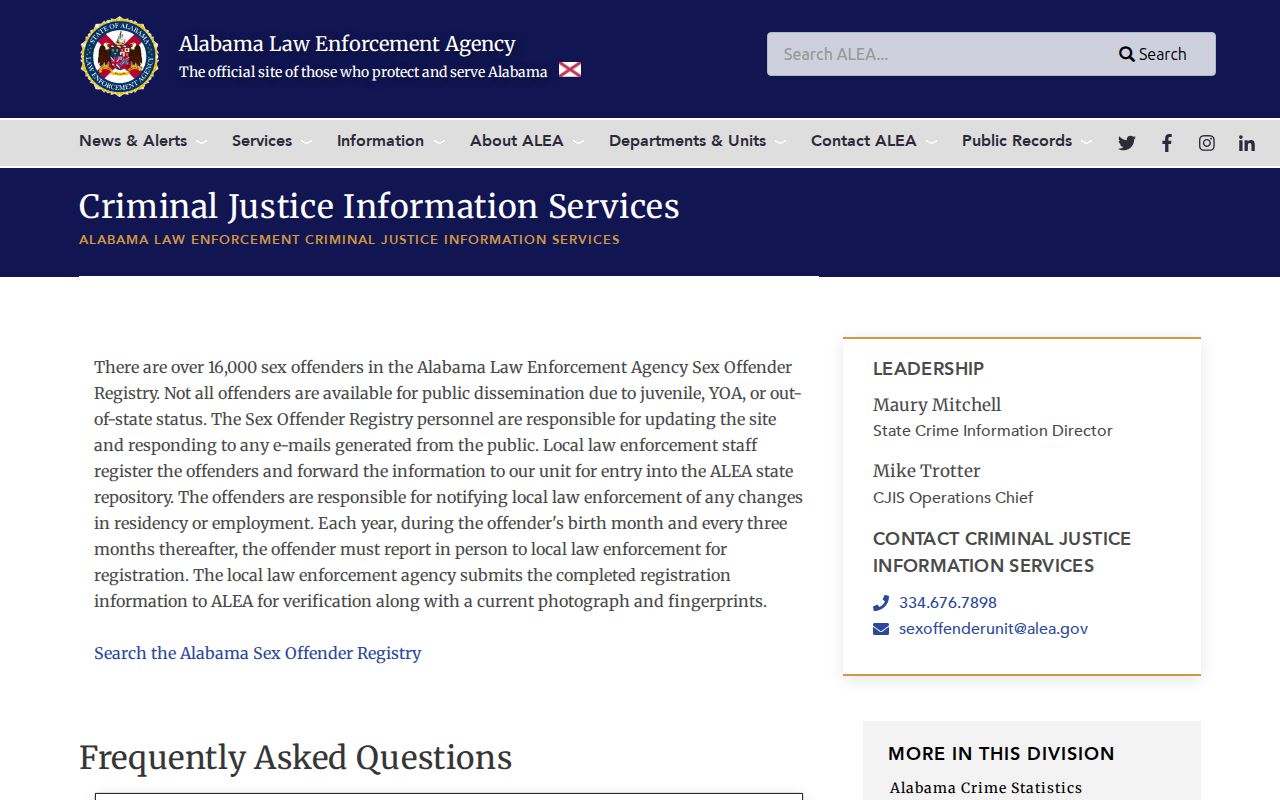
The official explanation also shows why not every qualifying event creates a public Clay County registry result at the same stage.
How to Search the Alabama Law Enforcement Agency Sex Offender Registry
ALEA links to a dynamic vendor interface for the official Alabama registry. The interface supports identity and geographic searching, but its anti-bot layer prevented a complete audit of every control. Search only with the categories that the current screen actually presents. Do not assume a radius choice, alert option, or filter exists until it is visible. The safe Clay County search method is simple:
- Open the official search from ALEA and read the use terms before entering any detail.
- Choose the identity or location path that the live interface offers, then enter only known facts.
- Compare the result list with the profile's name, aliases, photograph, physical description, and place information.
- Read the offense and status details, note the update context, and call local law enforcement if a Clay County address seems wrong.
The verified field categories are limited because the live controls can change. They are stated at category level rather than expanded into unsupported choices.
| Search Category | Type | Required | Verified Notes |
|---|---|---|---|
| Identity | Name-based search | Interface dependent | Name searching is supported; exact subfields were not fully captured. |
| Geographic | Address or location search | Interface dependent | Location searching is supported; no radius choices are claimed. |
| Results | Mapped or list display | No | Use the full profile to distinguish people and read statutory details. |
| Alerts | Interface feature | No | Availability depends on the current official interface. |
Inside a Registry Profile
Alabama Code § 15-20A-8 defines the public profile categories. A Clay County registry entry can show more than a name and address because the law calls for identifying, residence, vehicle, offense, and status facts. The same statute excludes several sensitive categories. That line matters: a public sex offender profile is a statutory disclosure record, not a full criminal history, police file, or court transcript.
| Name and aliases | Name, aliases, nicknames, and ethnic or tribal names required for public release. |
|---|---|
| Photo and description | A current photograph and physical description supplied through the registration process. |
| Places | Each residence plus school and work addresses required by the statute. |
| Vehicles | Plates and descriptions for listed land vehicles, aircraft, and watercraft used personally or for work. |
| Offense record | Conviction or adjudication history and the text of the provision for each triggering offense. |
| Status | Registration status, including an absconded designation when applicable. |
| Excluded data | Nonconviction arrests, Social Security number, victim identity, specified travel and online identifiers, and internet provider. |
The official public-information statute provides the source shown below.
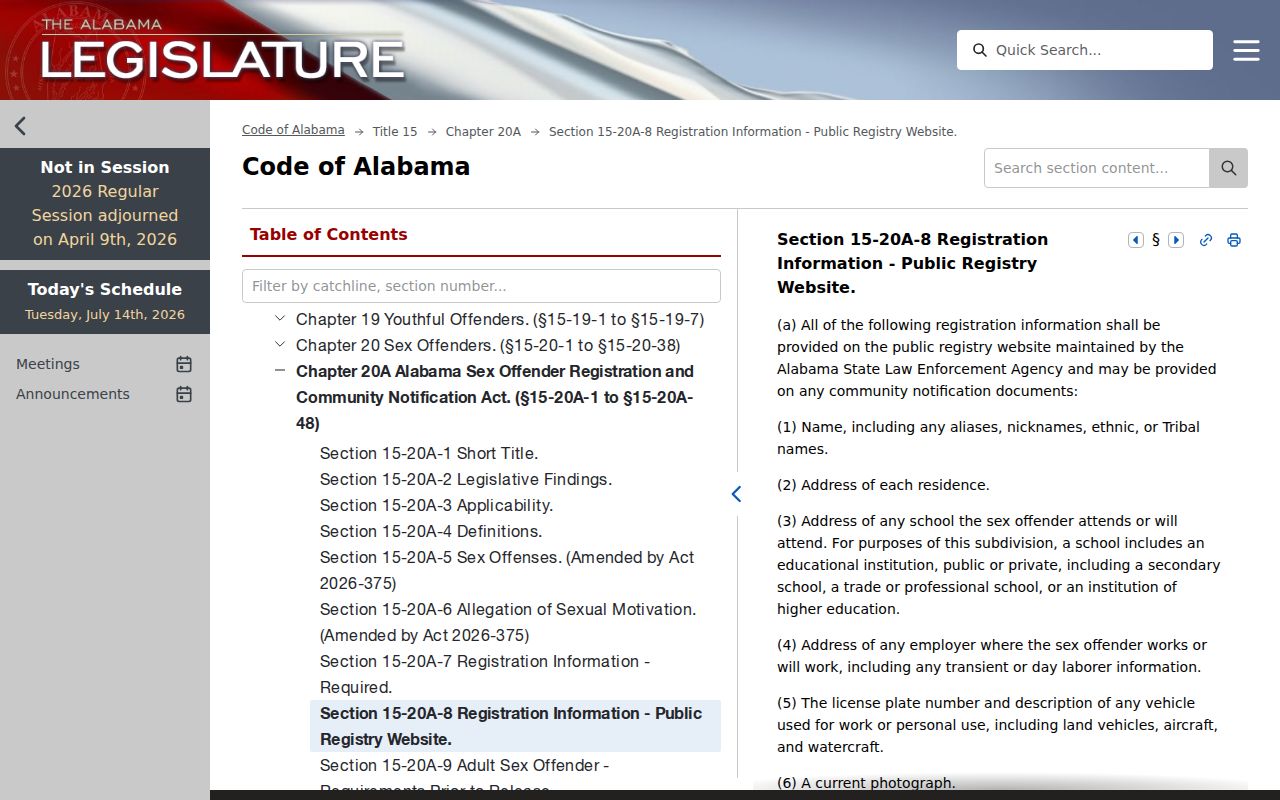
The statute sets both the breadth and the limits of what a Clay County sex offender search can disclose.
Clay County Records Have No Tier Score
Alabama does not publish a federal-style Tier I, Tier II, or Tier III risk score as the organizing label on these public profiles. Clay County sex offender records follow Alabama's offense-based ASORCNA duties. Importing a three-tier chart from another system would give a false account of Alabama law and could make a profile appear to offer an individual risk rating that it does not provide.
The Alabama registry definitions and duration statute is captured below.
Read the listed conviction, current status, and stated duties instead of turning the registry entry into a score of present danger.
Alabama Registration Levels and Requirements
The required duties table must reflect Alabama's real categories, not invented levels. Adult obligations are generally lifetime under § 15-20A-3(b). Certain serious juvenile offenses committed at age fourteen or older can carry lifetime registration with a petition route after twenty-five years. Other juvenile registration is generally ten years. Youthful-offender treatment is distinct, and publication depends on the governing conditions. ALEA's general information states that in-person verification occurs during the birth month and every three months after that.
| Documented Alabama Category | Duration | Verification and Visibility |
|---|---|---|
| Adult ASORCNA obligations | Generally lifetime | Birth month and every three months; public posting only when the statutory offense and publication rules apply. |
| Specified serious juvenile offense at age 14+ | Lifetime, with a petition route after 25 years | Publication and duties depend on the juvenile provisions and assessment. |
| Other juvenile registration | Generally 10 years | Most juvenile adjudications are not public unless assessed High Risk. |
| Youthful-offender or listed exceptions | Separate statutory treatment | Public visibility depends on age, offense, and other statutory conditions. |
Not every person convicted of a sexual offense appears in a public Clay County result. ALEA identifies exceptions involving juveniles, the Youthful Offender Act, some first convictions, and certain out-of-state due-process cases.
When Clay County Search Results Differ
A missing public result does not prove that no registration duty exists. ALEA explains that only offenses enumerated in § 15-20A-5 are posted. A first conviction for Indecent Exposure or Sexual Misconduct may require registration and verification without public posting under the stated rule. Most juvenile adjudications are not posted unless assessed High Risk. Some adult out-of-state, federal, military, or tribal cases await a due-process decision before publication.
Check spelling and aliases, then try the known place through the live official search. If the concern involves an Alabama address or a person who may not be complying, contact the agency that registers the person. The Clay County Sheriff's Office can receive a local address concern. ALEA's registry unit handles routine statewide questions at 334-676-7898 or sexoffenderunit@alea.gov. Neither channel should be replaced by speculation based on a blank result.
Note: Public exclusion can arise from statute or process, so a blank Clay County registry result is not a universal clearance.
Clay County Searches and NSOPW
The ALEA registry is the best source for Alabama-specific details and local follow-up. The National Sex Offender Public Website, run by the U.S. Department of Justice, adds a cross-state search layer. It is useful when a known person or address may connect to more than one jurisdiction. NSOPW does not replace ALEA or the Clay County Sheriff's Office. Its records still originate with participating jurisdictions.
The official national interface appears in the source image below.
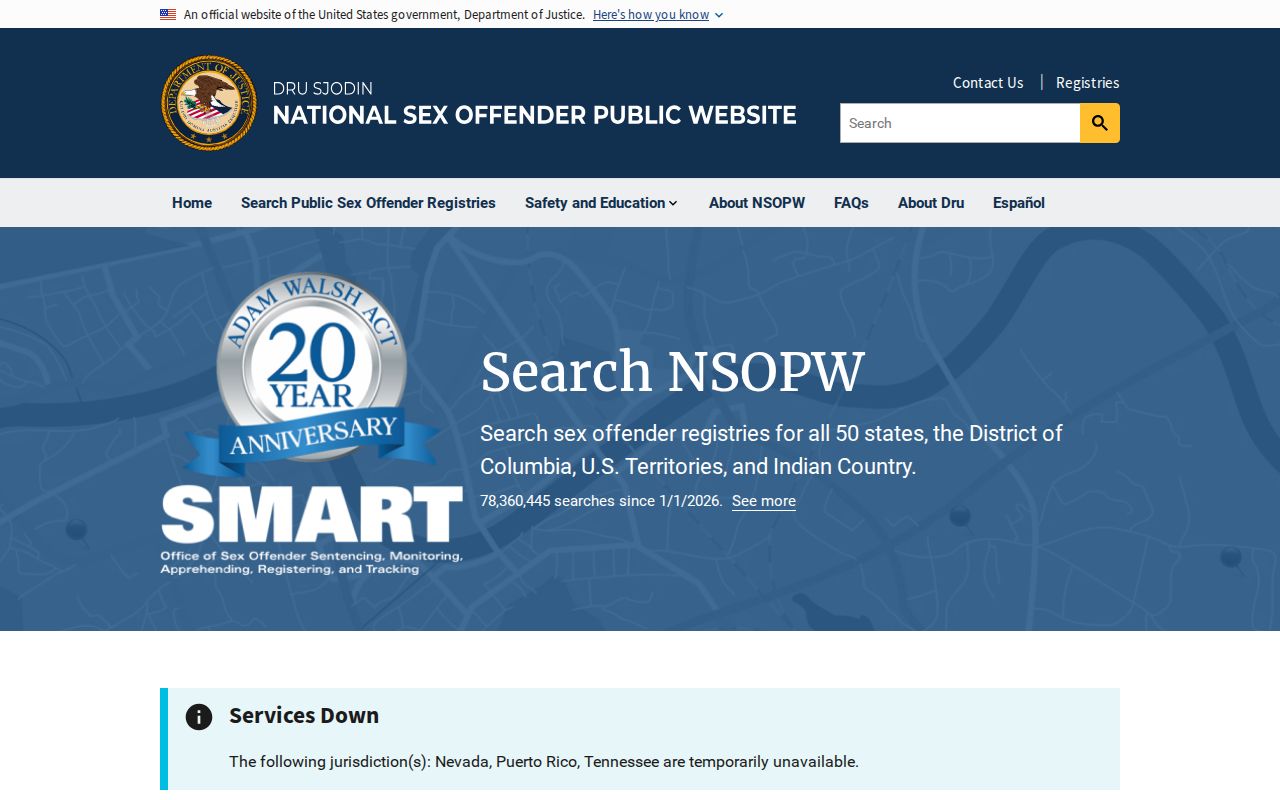
After a national match, return to the Alabama profile and local agency for the current Clay County registration facts.
Clay County Registry Community Rules
ALEA describes rules involving residence with minors and loitering. For an offense involving a child under twelve, it describes a five-hundred-foot loitering restriction around schools, child care facilities, playgrounds, parks, athletic fields, and businesses chiefly engaged in caring for, educating, or entertaining minors. The exact rule depends on the current statute and the facts. A map point alone cannot decide whether a legal violation occurred.
Use these restrictions as a prompt for official verification. If a location in Clay County raises a concern, give the sheriff a clear address and the reason it appears inconsistent. Do not attempt surveillance, contact, or enforcement. Local law enforcement can compare the current registration record with the facts and decide what action is lawful.
Report Clay County Registry Address Concerns
For a routine Clay County address concern, contact the Clay County Sheriff's Office at 256-354-7713 or at 41771 Highway 77, Suite 2, Ashland, Alabama 36251. Statewide routine questions can go to the ALEA Registry Unit. Give the agency the public profile, address, and specific mismatch. An old address can signal noncompliance, but it can also reflect a pending local update. The agency, not a private searcher, determines what the records and law require.
The official registry exemption provision offers another view of Alabama's statutory limits.
The provision is a reminder that publication and legal duty are related but not always identical questions.
Community Notification and Lawful Use
Registry information supports awareness, family safety planning, and official verification. It does not authorize threats, harassment, trespass, vigilantism, or unlawful discrimination. A registry listing is also not an individual risk assessment. The facts show a statutory registration record and stated status. They do not predict future conduct or replace current information from law enforcement.
Alabama Code § 15-20A-8 governs the public information released through the registry. Community members should use the official entry as a starting point, keep it in context, and report a concrete concern through the Clay County Sheriff's Office or relevant city police. Call 911 only for an emergency.
Registry misuse warning: Misusing Alabama registry information to harass, threaten, intimidate, or commit a crime is unlawful and may carry civil or criminal consequences under Ala. Code § 15-20A-8.